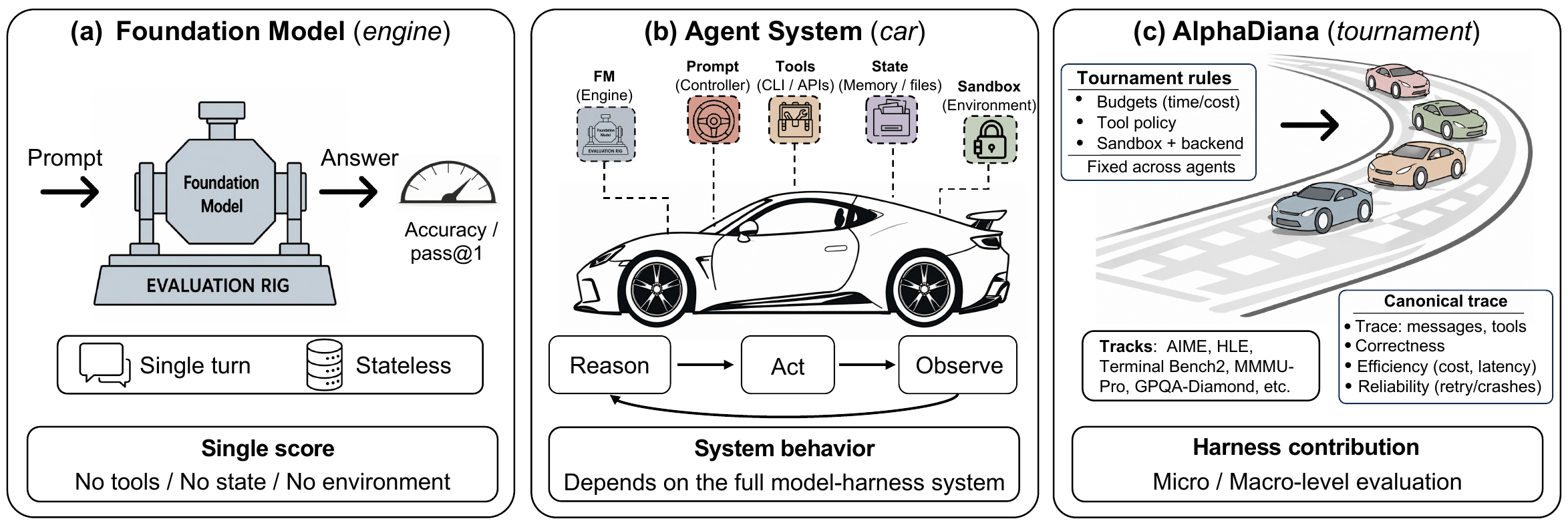
Reasoning agents such as OpenClaw are model-harness systems. The model supplies reasoning capacity, while the harness realizes it through tool use, multi-turn control, execution feedback, memory, and runtime policy. This shifts the paradigm from model reasoning to agentic reasoning. Existing evaluations often test models without a harness or fix a single harness, which conflates base-model reasoning with harness orchestration, leaving it unclear whether gains reflect stronger models or specific harness components.
System Architecture
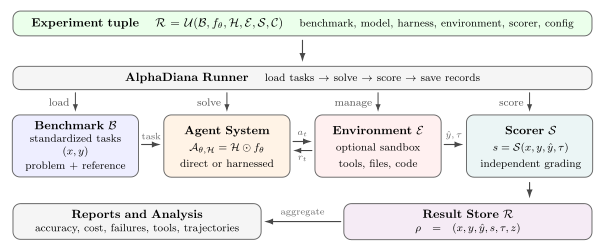
One runner, explicit evaluation boundaries
AlphaDiana resolves this conflation by making the evaluation process explicit, modular, and auditable: an experiment run is represented as ℛ = 𝒰(ℬ, fθ, ℋ, ℰ, 𝒮, 𝒞), where ℛ denotes saved results, 𝒰 the shared runner, ℬ the benchmark, fθ the base model, ℋ the agent harness,ℰ the execution environment, 𝒮 outcome and process evaluation, and 𝒞 the run configuration. Together, the model and harness form the evaluated agent 𝒜θ,ℋ = ℋ ⊙ fθ; Direct is its no-tool control.
What AlphaDiana standardizes
Harness-Aware Evaluation
Treat the evaluated unit as model plus harness, with Direct inference as the control.
Controlled Comparison
Match the model, task, scorer, and shared budgets while disclosing harness-specific runtime conditions.
Open Harness Interfaces
Run direct inference and reasoning agent harnesses through one shared result schema.
Verifiable Reasoning Tasks
Use deterministic or programmatic scorers for math, science, multimodal, and coding tasks.
Trajectory Attribution
Log actions, observations, resource use, termination states, and scoring metadata.
Sandboxed Execution
Run supported tool-using paths in task-scoped environments with explicit resource and reset policies.
Macro And Micro Studies
Compare whole harnesses, then ablate tools, skills, and memory to explain the score shifts.
Reproducible Reports
Regenerate summaries from saved records and inspect the evaluation loop in the dashboard.
Dashboard
Launch, monitor, and compare
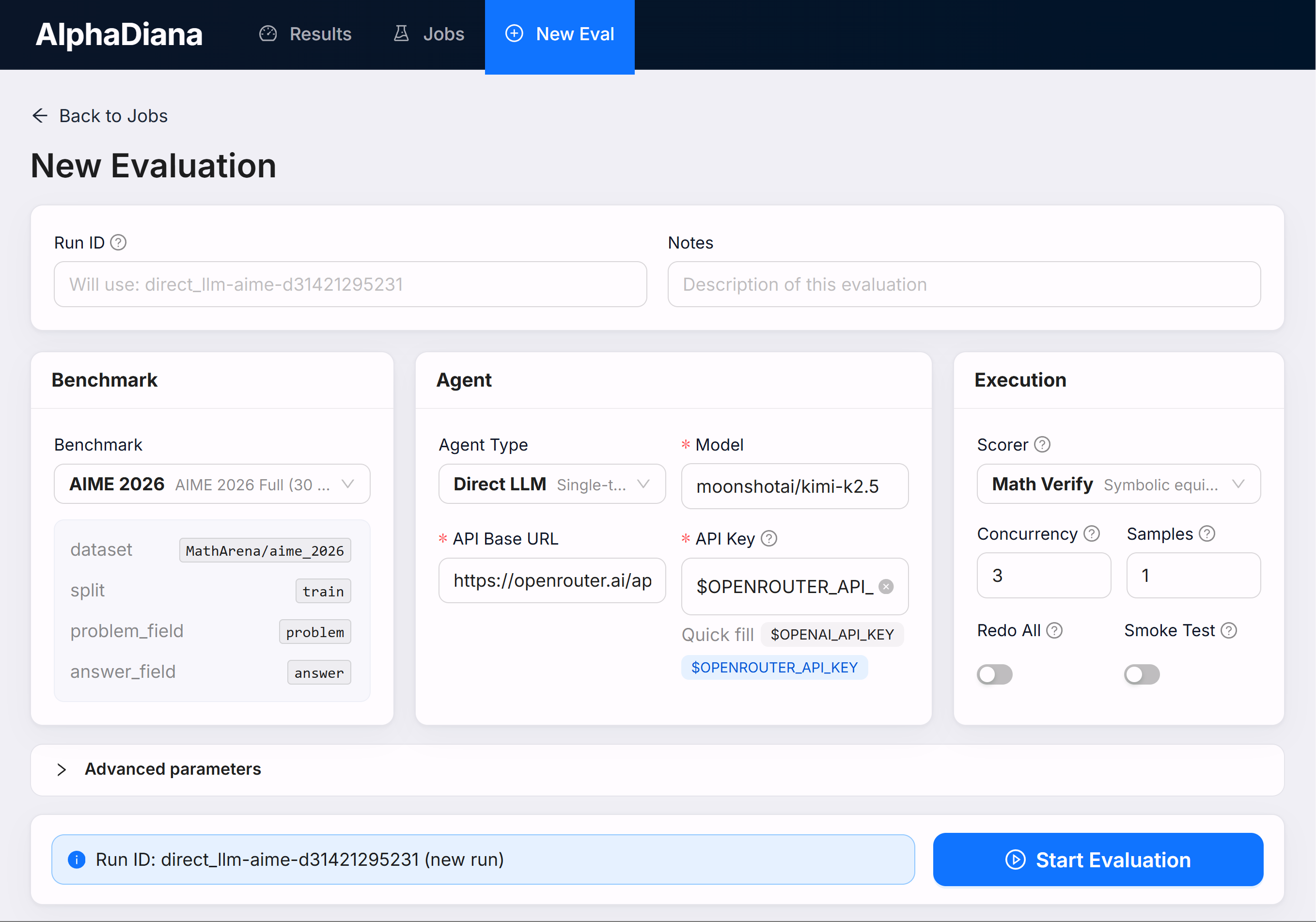
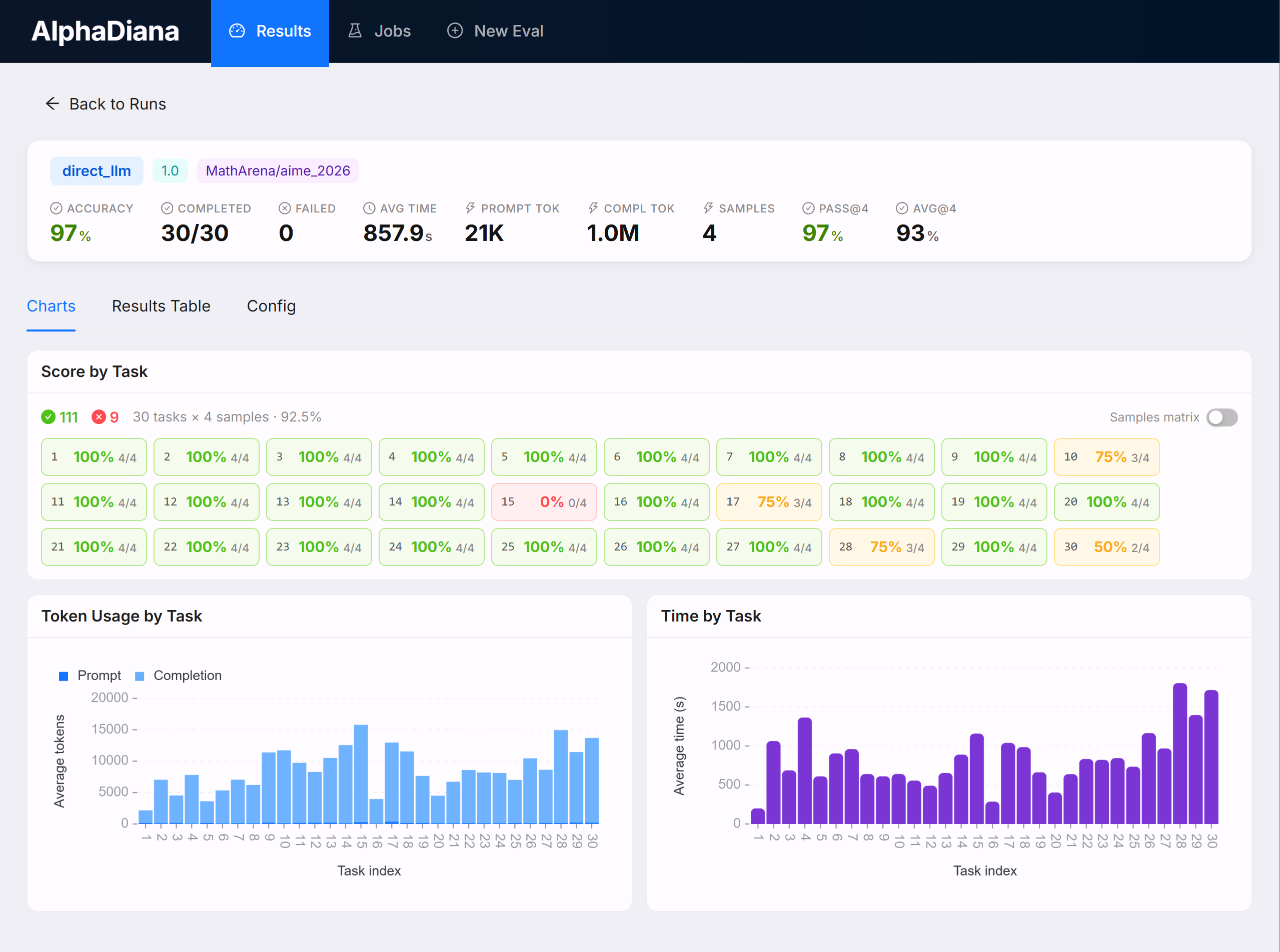
AlphaDiana turns a declarative configuration into a run, exposes it in a shared result store, and lets you monitor and compare evaluations side by side. The screenshots below illustrate the dashboard workflow for an AIME 2026 DirectLLM evaluation with four samples per problem. See the documentation for details.
Tournament Results
Harness gains depend on the model, task, and harness
The reported results compare the Direct no-harness baseline with open harnesses under matched models, tasks, scorers, and shared budgets while recording harness-specific runtime conditions. Harnessing is not a uniform upgrade: it lifts Gemma, sinks Qwen3.5, and produces mixed behavior on Kimi-K2.6. Green means the harness beat Direct; red means it lost ground.
| Harness | IMO-AnswerBenchAvg@1 | HLE-VerifiableAvg@1 | GPQA-DiamondAvg@1 | AIME 26Pass@4 | AIME 26Avg@4 | MMMU-ProAvg@1 |
|---|---|---|---|---|---|---|
| Directbaseline | 59.0 | 27.9 | 83.3 | 96.7 | 92.5 | 65.8 |
| OpenClaw | 59.5+0.5 | 24.2-3.7 | 85.4+2.1 | 100.0+3.3 | 97.5+5.0 | 56.8-9.0 |
| ZeroClaw | 61.5+2.5 | 29.1+1.2 | 86.4+3.1 | 100.0+3.3 | 96.7+4.2 | 66.4+0.6 |
| OpenCode | 62.5+3.5 | 24.0-3.9 | 87.9+4.6 | 100.0+3.3 | 96.7+4.2 | 67.4+1.6 |
Several harness rows improve on IMO, GPQA, and AIME in this selected comparison.
Values are percentages (higher is better); deltas are absolute differences vs. Direct. This view presents selected results from Table 1 of the AlphaDiana study. Consult the corresponding archived runs when citing exact values.
Quick Start
Run an AIME OpenClaw smoke evaluation
The command below uses configs/examples/openclaw_aime2024.yaml with the ROCK-managed OpenClaw runtime, downscaled to one problem and one sample. Connect it to a local model server or a hosted API in step 2. See the getting-started guide for setup details.
1. Install
git clone https://github.com/tmlr-group/AlphaDianacd AlphaDiana
# Required by the security preflight in the current releaseexport OPENCLAW_GATEWAY_TOKEN="$(python3 -c 'import secrets; print(secrets.token_urlsafe(32))')"
# Checkout-local conda env, dependencies, and servicesbash scripts/quickstart.sh
2. Run
# Activate the environment once per terminalsource scripts/activate.sh
# Use either a local OpenAI-compatible model server:export OPENAI_MODEL_NAME="your-local-model"export OPENAI_BASE_URL="http://127.0.0.1:8000/v1"export OPENAI_API_KEY="sk-local"
# Or a hosted API (replace the three values above):# export OPENAI_MODEL_NAME="your-api-model"# export OPENAI_BASE_URL="https://your-provider.example/v1"# export OPENAI_API_KEY="your-api-key"
# Validate and run a one-task AIME OpenClaw smokealphadiana validate configs/examples/openclaw_aime2024.yaml \  -o benchmark.config.max_tasks=1alphadiana run configs/examples/openclaw_aime2024.yaml \  -o run_id=quickstart_aime_openclaw_t1_k1 \  -o benchmark.config.max_tasks=1 \  -o num_samples=1 \  -o max_concurrent=1
# Generate a report from the smoke runalphadiana report results
Citation
@inproceedings{
  zhou2026reasoning,
  title={Reasoning Is More Than the Model: Harness-Aware Evaluation of Agents on Verifiable Reasoning Tasks},
  author={Zhanke Zhou and Zongze Li and Weikai Huang and Xuan Li and Chentao Cao and Xiao Feng and Xiangyu Lu and Jinbo Hu and Menghan Lu and Yi Xie and Nico Pelleriti and Shiyang Liu and Max Zimmer and Brando Miranda and Jiangchao Yao and Bo Liu and Sanmi Koyejo and Sebastian Pokutta and Bo Han},
  booktitle={ICML 2026 Workshop: AI as a Tool for Mathematics, Computer Science, and Machine Learning},
  year={2026},
  url={https://openreview.net/forum?id=fnHhEf0cSE}
}

@inproceedings{
  zhou2026reasoning,
  title={Reasoning Is More Than the Model: Harness-Aware Evaluation of Agents on Verifiable Reasoning Tasks},
  author={Zhanke Zhou and Zongze Li and Weikai Huang and Xuan Li and Chentao Cao and Xiao Feng and Xiangyu Lu and Jinbo Hu and Menghan Lu and Yi Xie and Nico Pelleriti and Shiyang Liu and Max Zimmer and Brando Miranda and Jiangchao Yao and Bo Liu and Sanmi Koyejo and Sebastian Pokutta and Bo Han},
  booktitle={3rd AI for Math Workshop: Toward Self-Evolving Scientific Agents},
  year={2026},
  url={https://openreview.net/forum?id=4vARlk9o95}
}